Hybrid Teams
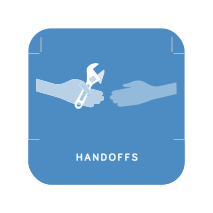
Handoffs card, MethodKit for Hybrid Teams
Card 22 of 65 · MethodKit for Hybrid Teams
  • ThemeGetting work done
  • CardCard 22 of 65
  • Questions5 to explore
  • StepSet up how work flows
Getting work done

Handoffs

How we hand over partly completed tasks

A handoff in a hybrid team is a moment where context either travels or it does not, and usually the cost of it not travelling shows up days later.

A handoff is when partly completed work moves from one person to another: handing over a project while someone is on leave, passing a task to a different time zone, or picking up where a colleague left off. In person, a handoff can happen over lunch or a quick walk. In a hybrid team, the context that lives in someone's head does not automatically make the journey.

What makes a handoff work is not the tool or the format. It is the habit of writing down where things stand, what decisions have been made, what is still open, and what the other person needs to know to carry on without asking questions. A written handoff is not extra work; it is the work.

Make it explicitAgree on a simple handoff format for your team: what information must travel with the work whenever a task or project changes hands.

How strong hybrid teams handle it

The same building block, handled well. These are patterns from teams that work well across locations, offered as illustrations to react to, not rules to copy.

Write a 'where it stands' note

Before a handoff, the outgoing person writes a short note: what is done, what is in progress, what is blocked, and what decisions are still open. A few paragraphs is enough if they are honest and specific.

Name the open questions

Good handoffs explicitly name what is unresolved so the incoming person does not have to guess. 'I was not sure about X' is more useful than silence.

Overlap when time zones allow

If the people handing off and taking over share any working hours, a short sync call to walk through the written note reduces the risk of things falling through the gap.

Create a handoff template

Teams that do handoffs regularly often have a shared template: status, next steps, blockers, key contacts, and important links. Using the same structure every time means nothing gets forgotten.

Questions for your team

Use these on your own or in a group. There are no right answers, only better conversations.

  1. How does your team currently hand over work, and what information usually gets lost in the process?

  2. If someone went on sick leave today, how long would it take their backup to understand where everything stands?

  3. Where does handoff documentation live, and is it easy to find after the fact?

  4. What kinds of work on your team are most vulnerable to a bad handoff, and why?

  5. How do you know when a handoff has actually worked?

Watch for

  • Verbal handoffs in hybrid teams leave remote colleagues with no record. If someone was not on the call, they have nothing to refer back to.
  • The person handing over often underestimates how much context they are carrying in their head. What feels obvious to them is invisible to the person taking over.
  • When handoffs are rushed or informal, it is usually the remote or async colleague who pays the price, because they cannot follow up in real time.